









In testifying before the Senate Budget Committee, Ben Bernanke, Chairman of America's Federal Reserve Bank, hinted strongly that further rate cuts would be necessary to stabilize the US economy. Last week, the Forex Blog covered an editorial which suggested that Bernanke knew something about the state of the economy that the American public did not, which his testimony seemed to confirm. Bernanke testified that the Fed is also committed to fighting inflation, but the emphasis was clearly on spurring economic growth. As a result, futures markets are pricing in a rate cut of 50 basis points, projected for the next month. The forex markets were unambiguous about the implications of this development for the Dollar.
Fed cutting rates doesn't mean USD will recover in near term. But the long term effect of it will benefits those carry pairs that rely much on overnight interest rate earnings, it will benefit those hedging correlated pairs, trading strategies that are sensitive to stock prices and yields. Cutting rates will present some nice long term opportunities. I'm not saying that global crisis is over, but it is looking like daylight may be ahead.
Bernanke Hints Rate Cuts

Risk Aversion Benefits the Dollar
While most of the currency pairs are in a loose range bound as talk and evidence of a US economic recession builds, the Dollar has witnessed a slight upswing. How to explain these seemingly contradictory trends? The rationale is surprisingly simple. While a US recession would predictably hit the US harder than other countries, it would still hamper growth abroad, especially in emerging markets that have come to depend on exports to the US to drive growth. Accordingly, investing in such emerging markets becomes relatively more risky than investing in the US, which is still considered to have the world's most stable investing climate from a long-term perspective. Thus, as risk aversion rises, so does the Dollar.
Currency Trader Magazine February 2008 issue
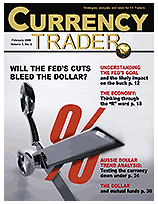
February issue of the Currency Trader Magazine is now available to download.
Inside this issue. There are 2 good read articles concerning the last month Fed's drastic rate cuts and how it will affect the USD.
Download it HERE.
Why the Fed Cut Rates
It seems self-evident that the Fed is easing monetary policy because it is trying to stimulate the economy and shore up confidence in capital markets by making credit less expensive. Dig a little deeper, however, and a more nuanced picture begins to emerge. Conspiracy theorists believe that the Fed knows something that investors don't, perhaps that the subprime mortgage situation is more serious than the public is being led to believe. Accordingly, the theory goes, it is trying to prevent a complete collapse of the financial system. Another theory holds that the Fed is cutting rates because it has nothing to lose by doing so. Inflation is still low, from a historical standpoint, and the Fed may be trying to inject liquidity into the financial markets before it is too late. Yet another theory holds that the Fed is deliberately targeting a weak Dollar and high commodity prices, as the former benefits the US directly by narrowing the trade imbalance, and the latter benefits the US indirectly by helping emerging market economies, which are relatively more dependent on commodities.
Rate Decisions to Drive FX
Article by Korman Tam of forexnews.com
Central bank policy decisions will dominate the headlines this week particularly given the drastic rate cuts from the FOMC recently. While the Fed has slashed its benchmark lending rate by 125-basis points within the past two weeks to 3.0%, the dollar has not sold off as sharply as would be anticipated given the interest rate gap. Last Friday's dismal non-farm payrolls number, which revealed a loss of 17k jobs - its first since 2003, failed to prompt a sustained sell-off in the greenback. With much of the US economic malaise and additional rate cuts priced into the dollar, traders will focus on the direction of central bank policy moves this week.
Yen as Proxy for Risk Aversion
The US stock market has lost over 10% of its capitalization since reaching an all-time high in October of last year. Meanwhile, the Japanese Yen has climbed at least as much in proportional terms since bottoming out around the same time. Coincidence? At least one analyst doesn't think so. Because of the steadfast popularity of the carry trade, the Japanese Yen appears to have developed an inverse correlation with the US stock markets. The reasoning is actually quite simple. When aversion to risk is low, investors borrow in Japanese Yen and make investments denominated in other currencies, the Dollar for one. When risk-aversion increases, as it has in the current economic environment, investors have been quick to close out their carry trade positions, causing the Yen to rise.
Read more here: Marekt Correlation
Fed Lowers Rates...Again
Last January 30, the Federal Reserve Bank lowered interest rates for the second time in as many weeks, bringing its benchmark federal funds rate down to 3.00%. The Fed has now lowered rates by 2.25% since August. The move came as a relief to investors, who now see that the Fed is serious about preventing the economy from slipping into a full-scale recession.
However, it remains to be seen whether the rate cuts will provide the necessary boost to the economy or instead prove too little too late. As far as the Dollar is concerned, the rate cuts carry two (conflicting) implications. On the one hand, the economy and stock market could rally, which would likely be matched by a Dollar rally. On the other hand, the interest rate differential between the US and EU is now a 1% and risk-averse investors hungry for yield will be hard-pressed to justify shifting capital to the US.
